
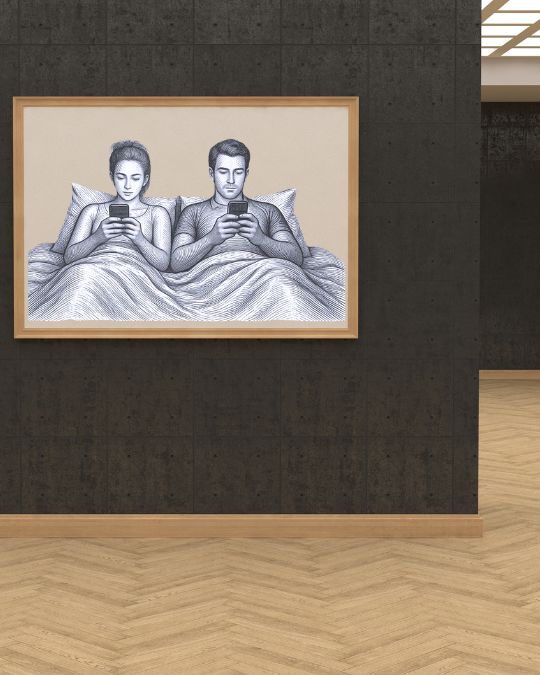
Are you aware you have a new competitor? One of your biggest competitors might not be the gallery across town. Nope. It’s every screen in your collector’s pocket. Your prospective art buyers wake up every morning and immediately encounter social media, streaming entertainment, podcasts, newsletters, shopping apps, travel inspiration, and a constant flow of information. We all do. Against that kind of attention suck, a beautifully designed exhibition announcement may never receive a second glance.
The challenge facing your gallery today is not simply visibility. Its relevance. So, how do you fight that?
This article is about understanding how attention works and how your gallery can build meaningful relationships with people who don’t yet think of themselves as art collectors. Frankly, that is where the next generation of buyers will come from.
Your gallery is Competing for Attention, Not Just Art Sales
The younger affluent audience often spends discretionary income on experiences before objects. We have known this for some time now.
When the challenge is getting people into the gallery, the question you need to ask yourself is How do we create an experience worth interrupting their day for? Trust is the scarcest currency; for your gallery to grow with a new generation of buyers, it needs to become a reliable guide to what’s worth paying attention to.
You’re competing against the entire experience economy that lives in your collector’s pocket: beautifully produced travel reels, restaurant openings, boutique wellness retreats, private clubs, tastemakers’ Substacks, and an endless stream of culture-as-content. In that environment, attention isn’t won by announcing an exhibition and hoping people rearrange their schedules. Attention is earned by becoming relevant often enough, and meaningfully enough, that your gallery starts to feel like a place people belong, not just a place they visit.
This is why the younger affluent audience’s preference for experiences over objects matters so much. It doesn’t mean they don’t value material things; it means they lead with identity, story, and social context. They’ll spend on a dinner not because it’s “food,” but because it signals taste, gives them a night to remember, and connects them to people they want to be around. The purchase is justified by the experience.
Art is uniquely capable of delivering those same emotional outcomes: identity, meaning, discovery, connection. But galleries often market it as inventory or as solely the artist’s narrative. When art is introduced as a cultural experience first, and an object second, it becomes easier for non-collectors to say yes. Yes to coming in, yes to staying longer, yes to asking questions, and eventually yes to buying.
So the strategic pivot for you might be to stop treating the exhibition or the art on the walls as the only “product” and start treating the gallery as a cultural host. A host doesn’t just display; they create low-stakes entry points, such as short guided walkthroughs and intimate conversations, rituals people can return to, so a new audience can build familiarity over time. For example:
- First Thursday: 30-minute Art + Wine Guided Walkthrough (same time every month)
- Sunday Salon: one artwork, one story (20 minutes + mingling)
- In the gallery cards about how to look at this work (3 prompts on a printed card)
- “Collector home tour” presentation in the gallery. slides only (a designer shares a project; you share art placement ideas)
- Gallery Listening Lunch Hour: Member of the month chooses the playlist + one artwork they love” (community spotlight)
These and similar experiences are worth considering because it train people to come back even when they’re not “buying” art. Repetition builds habit; habit builds trust; trust builds sales. I do recommend you keep it time-boxed and the same format every time.
The goal is to build a relationship with someone who doesn’t yet call themself an art collector, but already has the curiosity, taste, and discretionary income to become one. That relationship is built the same way it’s built in every other experience category.
- Repeated positive touchpoints
- A sense of inclusion
- Feeling that this place understands them.
Over time, these prospective buyers stop saying “we should go to that opening” and start saying “let’s go there, something interesting is always happening”. Your experiences become part of their lifestyle. That’s when attention turns into loyalty and sales.
Stop Marketing Only to the Art World
If you want to attract first-time and next-generation buyers, you can’t rely on language that only “art people” understand. I see a lot of gallery communications that assume the reader already knows the codes: contemporary art references, exhibition language, collecting etiquette, and why a particular artist matters. But when your messaging starts after that learning curve, you might unintentionally exclude the exact people you’re trying to bring closer. And we don’t want that to happen.
Many galleries are excellent at speaking to collectors and surprisingly poor at speaking to future collectors. You want to be good at both.
Future collectors may already have cultural curiosity and disposable income, but they’re often motivated by the same things that guide other high-end purchases: creating a beautiful home, expressing personal identity, pursuing creativity, and living a life that feels meaningful. They care about entrepreneurship, travel, design, sustainability, family, legacy, and community because those are the areas where they’re building a life they’re proud of.
Art intersects with all of these interests, but the gallery has to build the bridge.
A practical way to refresh your exhibition marketing is to ask yourself a few simple questions:
- Why would someone who has never purchased art care about this show?
- What emotional need does the work address—comfort, wonder, play, status, belonging, reflection?
- What broader conversation does it connect to, and what life experience does it echo?
Play a New Role to Make Art Part of Everyday Life
If your goal is to reach future collectors, growth may come from becoming visible inside the broader cultural ecosystems your audience already participates in. In other words, make art feel less like a niche destination and more like a natural part of the life they’re building.
This is where collaboration can become an advantage. The point isn’t to partner with random brands for novelty. It’s to identify adjacent industries in your region that serve the same educated, affluent audience and create genuine, repeatable points of connection.
Interior designers and architects can help audiences imagine art in real spaces and real lives. Luxury real estate introduces art during moments of aspiration and transition, when people are actively making identity-defining decisions. Hospitality partners such as hotels, restaurants, and resorts offer built-in foot traffic and a context where discovery already feels natural. Fashion shares the same language of taste and self-expression, and wellness and lifestyle brands align with the emotional outcomes art can provide: calm, meaning, and atmosphere.
Universities and professional organizations can also be powerful, because they gather intellectually curious people who may become collectors over time especially when the gallery can be seen as an educator and guide, not a seller. Ultimately, the strategy is simple: Ask yourself where do your future collectors already spend their time in your market and how can you meet them there with something valuable?
Many of these industries would welcome an art partner because you enhance their client experience as well, with regularly refreshed art and narrative in their spaces.
Your Gallery is a Guide, Not Just a Seller
This is where your educational content becomes a great sales and marketing tool. Many exhibitions are presented with language that feels inaccessible, even to people who genuinely like what they’re seeing. The gallery’s role is not merely to display artwork. It is to create a better understanding of what the artist is doing and how that enhances a collector’s life.
Four Stories Your Gallery Should Tell
1. Why This Artist Matters
- What makes their perspective unique?
- What are they wrestling with?
- Why should a non-art expert care?
2. Why This Work Exists
- What inspired it?
- What problem, memory, question, or experience gave birth to it?
3. What Experienced Art World People Notice
This is a brilliant angle. Create content such as:
- Five details experienced collectors notice immediately.
- How do collectors evaluate a body of work?
- Why does consistency matter?
- How does scale affect impact?
- What makes a work memorable over time?
This helps beginners feel included rather than uninformed. These five things would make excellent long-form content that can be repurposed in many ways as you talk about your artists on various marketing channels and sales follow-up assets.
4. The Story Behind the Exhibition
This may be the most overlooked opportunity I see over and over again. Many exhibition themes are abstract, philosophical, or highly conceptual. If that is the case with one of your shows, try to translate those ideas into more human language.
For example, instead of:
“An exploration of liminal spatial relationships and fragmented memory.”
Try:
“This exhibition asks a question many of us recognize: What happens when the places we once knew begin to change, and how do those memories continue to shape us?”
The second version invites participation and just feels more accessible to a future collector. We can all relate to that in our own lives.
To the Point

Attention is rarely won with a single post or art opening. It is earned through repeated, valuable interactions. As you think about how your gallery is positioned and how you might compete better with screens for the attention your artists deserve, think about these questions.
- Are we creating experiences people want to attend?
- Are we speaking to future collectors or only existing ones?
- Are we showing up where our audience already spends time?
- Are we making art easier to enter without making it simplistic?
- Are we consistently creating curiosity?
Because in the coming decade, the galleries that thrive won’t necessarily be those with the largest marketing budgets or even the most Instagram followers. They’ll be the ones who become indispensable sources of discovery, connection, and meaning. Gallery Fuel helps galleries build the systems, content, and collector relationships that turn attention into long-term growth. We are all guilty of endless scrolling on occasion; the goal isn’t simply to be seen. It’s to become memorable. If I can help your business grow, let’s chat.
You might also enjoy
Why Younger Art Collectors Hesitate and How Galleries Can Remove the Friction


Leave a Reply